

Determining fault in a multi-car pileup involves a detailed investigation into the sequence of impacts, physical evidence, and witness accounts, all interpreted through Mississippi's liability laws. Unlike a simple two-car collision, fault may be shared among several drivers, and the initial at-fault driver isn’t always the only one held responsible.
A car accident lawyer uses the evidence from the crash scene and legal principles to build a case that accurately shows how the pileup occurred and who bears the legal responsibility.
Insurance companies for each driver launch their own investigations, and their conclusions often conflict. An attorney can challenge incorrect fault assignments and work to secure fair compensation for your injuries and property damage.
Key Takeaways
- More than one driver may be legally responsible for damages in a multi-car collision.
- The final determination of fault relies heavily on evidence like police reports, vehicle damage, and witness testimony.
- Mississippi operates under a pure comparative negligence system, meaning you may recover damages even if you’re partially at fault for the multi-car pileup.
- An experienced attorney is your best asset for investigating the crash and protecting your rights against multiple insurance companies.
Using Evidence To Determine Fault in a Multi-Car Pileup
Evidence is the foundation of any car accident claim, especially one with multiple vehicles. With so many conflicting stories and points of view, physical proof and objective analysis become the most reliable tools for uncovering the truth.
Your legal team's investigation seeks to reconstruct the accident from start to finish. This process identifies each driver's actions in the moments leading up to the first crash and the subsequent chain reaction of impacts.
Each piece of evidence is a clue that helps create a full picture of the events. Examples include:
- Official Reports: The initial police report contains the officer's diagrams, notes, and any citations issued, though it’s often just the starting point of the investigation.
- Physical Evidence: The location and severity of the vehicles' damage, along with skid marks and debris on the road, tell a story about the force and sequence of the impacts.
- Visual Documentation: Photographs and videos taken at the scene provide an objective record of the vehicles' final resting positions, road conditions, and visibility before the area is cleared.
- Witness Accounts: Statements from independent witnesses can provide a neutral perspective on how the pileup started, often clarifying the conflicting stories from the involved drivers.
- Expert Analysis: Accident reconstruction experts use physics and engineering to create a scientific model of the collision, offering an authoritative opinion on how the pileup unfolded.
Mississippi's Comparative Negligence Law
Mississippi follows a pure comparative negligence rule for personal injury claims. The rule states that you can pursue compensation from other at-fault parties even if you’re partially responsible for the accident. Your percentage of fault simply reduces your total recovery.
For example, a jury might find you were 5% at fault for the accident. If your total damages total $100,000, you can still recover $95,000.
Insurance adjusters are very familiar with this law and frequently use it to their advantage. They may try to shift a small amount of blame onto you to reduce the amount they have to pay.
Without a proper investigation and a strong legal argument, you might accept more fault than you actually bear. An attorney who understands multicar fault laws can protect you against unfair blame, keeping the focus on solid evidence, not just on an adjuster's opinion.
Common Scenarios in Chain-Reaction Accidents
Multi-vehicle accidents happen in many different ways. The specific dynamics of the crash dictate how investigators approach determining fault in a multi-car pileup.
Certain scenarios appear more frequently on Mississippi roads, from I-20 in Jackson to US-98 in Hattiesburg to US-45 in Meridian. Each presents a unique set of challenges for establishing liability.
While the "middle" drivers in a pileup often feel they had no chance to react, their actions may also be examined for following too closely or getting distracted. These factors can complicate the fault determination process.
The Classic Rear-End Chain Reaction
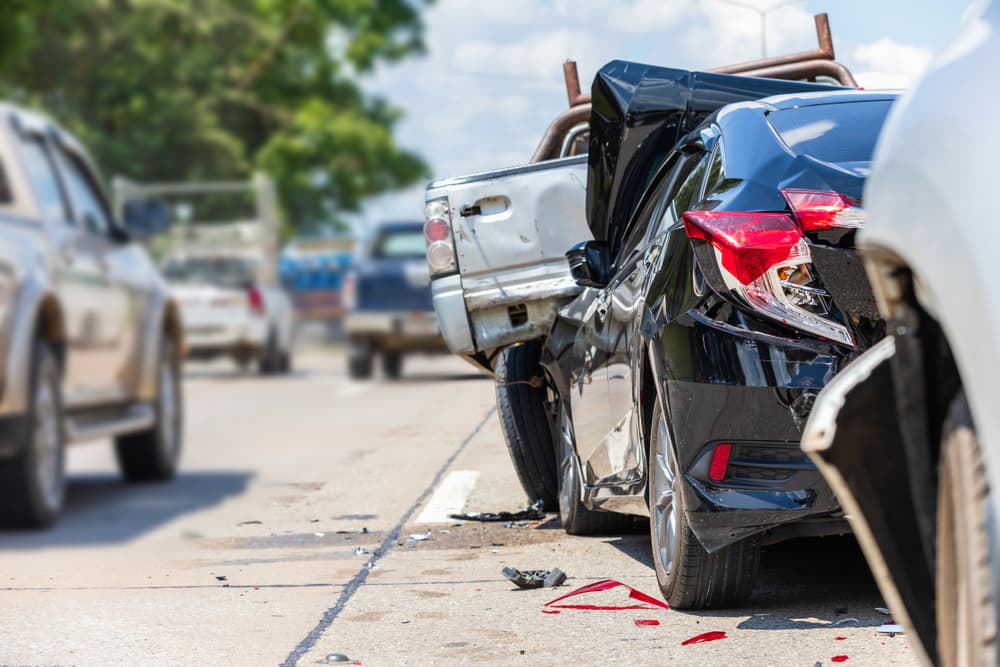
This well-known pileup typically begins when one driver fails to stop and crashes into the vehicle ahead, pushing it into the next car, and so on. In most cases, the driver who caused the initial rear-end impact is held primarily liable.
The first driver's failure to maintain a safe following distance or pay attention sets the entire crash in motion. Chain reaction accident liability isn’t always as simple as blaming the last driver in line. The actions of every driver in the sequence get a close look.
For instance, if the lead car stopped suddenly without cause or had inoperable brake lights, that driver may share some fault.
The "Phantom Vehicle" Pileup
Sometimes, a pileup is caused by a driver who creates a hazard but never actually makes contact with another car. This "phantom vehicle" might cut another driver off, causing them to slam on their brakes and trigger a chain reaction behind them. The phantom driver then drives away, leaving a chaotic scene behind.
Proving the role of a phantom vehicle is difficult and requires strong witness testimony or video evidence. Without proof of this other driver, insurance companies often try to place blame on the drivers who were directly involved in the collisions.
Pileups Caused by Road or Weather Conditions
Poor weather, such as heavy rain or dense fog, dramatically reduces visibility and stopping distances. Road hazards such as large potholes, unmarked construction zones, or debris can also cause a driver to react suddenly.
While weather or road conditions contribute to a pileup, they don’t automatically absolve drivers of responsibility. All drivers have a duty to adjust their speed and attention to match the current conditions.
Here are some key factors in weather-related crashes:
- Driver Speed: A primary focus is on whether drivers were going too fast for the weather conditions.
- Following Distance: Investigators check if drivers left enough space to stop safely in low-visibility situations.
- Vehicle Condition: The state of tires, brakes, and windshield wipers can also be a contributing factor.
5 Steps To Take After a Multi-Car Wreck
If you have already addressed your medical needs, you can take several organized steps to protect your rights and prepare for the claims process. What you do in the days and weeks following the crash has a direct impact on your case.
Focus on documentation and securing legal representation to manage the complexity ahead:
- Organize Your Documents: Gather every piece of paper related to the accident. This includes the police report, the information exchanged with other drivers, photos from the scene, and all correspondence from any insurance company.
- Document Your Injuries and Recovery: Keep a journal and track your medical appointments, the symptoms you experience, and how your injuries affect your daily life. This record helps connect your medical treatment directly back to the accident.
- Don’t Speak With Other Insurance Adjusters: The other drivers' insurance companies will likely contact you and ask for a recorded statement about how the crash occurred. You have no obligation to provide one. These calls are often designed to get you to say something that can be used to assign fault to you. Politely decline and direct them to your attorney.
- Preserve Any Evidence You Have: Make backups of any photos or videos you have of the accident scene or your vehicle. Don’t repair your vehicle until your attorney has had a chance to have it inspected and documented.
- Contact a Car Accident Attorney: Contacting a lawyer early in the process allows them to start their investigation while the evidence is still fresh and witnesses' memories are clear.
How a Lawyer Helps Minimize Your Fault in a Multi-Car Pileup
A multi-car pileup isn’t a typical accident claim. The complexities of shared fault and multiple insurers make it very difficult to handle on your own.
An experienced Mississippi car accident attorney is your advocate and your investigator. Their job is to cut through the confusion and build a case based on facts, not on the self-serving opinions of insurance companies.
Their knowledge of multi-car accident fault laws and experience with the Mississippi car accident investigations provide a significant advantage. A lawyer works to keep you from being unfairly blamed, helping you recover full compensation for your losses.
A lawyer’s assistance often includes these specific actions:
- Independent Investigation: Your legal team conducts a private and thorough investigation beyond the initial police report to uncover critical evidence that insurance adjusters may have missed.
- Expert Collaboration: Your attorney may retain accident reconstruction experts who use science and engineering principles to create detailed reports and animations that show the crash sequence.
- Proactive Evidence Gathering: Your lawyer can locate and interview witnesses, subpoena cell phone records, and secure surveillance footage from traffic cameras and nearby businesses to build a complete factual record of the event.
- Strategic Communication: Your attorney manages all communication with the multiple insurance companies, protecting you from recorded statements and lowball tactics.
- Legal Strategy: Your lawyer compiles all the evidence into a clear and persuasive legal argument, which they present to the insurers in a demand letter to establish fault and justify your compensation.
FAQ for How Is Fault Determined in a Multi-Car Pileup?
Can Multiple Drivers Be at Fault in a Car Accident?
Yes, multiple drivers may share fault in a multi-car pileup. Mississippi's comparative negligence law allows liability to be divided based on each driver's percentage of responsibility. This is a common outcome when multiple parties contribute to a crash.
For example, one driver may be 70% at fault for starting the chain reaction, while another may be 30% at fault for following too closely and being unable to stop in time.
What Is the Deadline for Filing a Car Accident Claim in Mississippi?
In Mississippi, you generally have three years from the accident to file a lawsuit for personal injuries. If you fail to file a claim within this period, the court will likely dismiss your case, and you’ll lose your right to pursue compensation permanently.
Speak with an attorney well before the three-year deadline (statute of limitations) to allow adequate time to investigate the claim, gather evidence, and file the necessary legal paperwork.
What Happens if the At-Fault Driver Has No Insurance?
If the driver who caused the pileup is uninsured or doesn’t have enough coverage to pay for all of your damages, you may be able to file a claim through your own insurance policy. This is possible if you have Uninsured/Underinsured Motorist (UM/UIM) coverage.
UM/UIM protect you in these exact situations by covering medical bills, lost wages, and other damages that the at-fault driver's policy cannot. An attorney can review your policy to see if you have this coverage and help you file the claim.
How Is Fault Determined in a Multi-Car Pileup When Bad Weather Is a Factor?
When bad weather contributes to a pileup, the investigation focuses on whether the involved drivers were operating their vehicles appropriately for the conditions. Every driver has a legal duty to slow down and increase their following distance in conditions like heavy rain, ice, or fog.
A driver who fails to do so and causes a crash may be negligent. Therefore, while weather is a contributing factor, fault in these situations may fall onto drivers who failed to adapt their driving to the hazardous conditions.
Why Do I Need a Lawyer if the Police Report Says I’m Not at Fault?
A favorable police report is a great start, but it’s not legally binding. Insurance companies can and often do contest the findings in a police report. They conduct their own investigations and may interpret the evidence differently to protect their financial interests.
A Mississippi car accident attorney uses the favorable police report as a strong piece of evidence, but also builds a more comprehensive case to counter any attempts by insurers to shift blame back onto you.
Put a Mississippi Fighter in Your Corner

The chaos of a multi-car pileup doesn’t have to define your future. You need clear answers and strong representation to cut through the noise of competing insurance adjusters and conflicting stories.
The right legal team can take the pressure off your shoulders and focus on building a powerful case that establishes the facts and secures the compensation you need.
If you were injured in a multi-car accident in Mississippi, get an advocate on your side. Contact Richard Schwartz & Associates at (601) 800-5559 for a free consultation to discuss your case.